Robust Safeguards Affirm the Integrity of Pakistan’s Strategic Arsenal
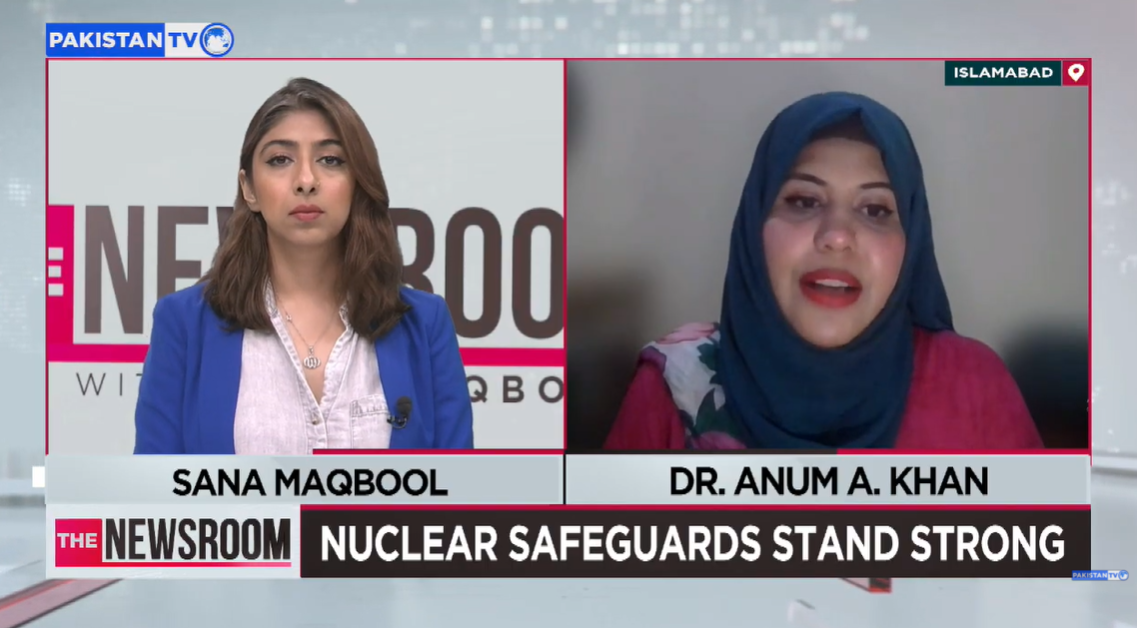
Dr Anum A. Khan on Pakistan Television’s Newsroom with Sana Maqbool
27 July 2026
Guest: Dr. Anum A. Khan
Interview Transcript
Host
Recent international media coverage, particularly a German documentary, has once again raised questions regarding Pakistan’s nuclear programme and its security architecture. Pakistan, however, has consistently maintained that it possesses a robust command-and-control system and internationally recognised safeguards for its strategic assets.
To discuss these issues, we are joined by Dr. Anum A. Khan, Assistant Professor at the Department of Aerospace and Strategic Studies, Air University.
Dr. Khan, thank you for joining us.
Pakistan has long maintained that it is a responsible nuclear state with comprehensive safeguards governing its strategic arsenal. Could you explain why these safeguards matter and why it is important for the international community to assess Pakistan’s nuclear programme objectively?
Dr. Anum A. Khan
Thank you very much for having me.
I would like to begin with a personal observation. In 2011, I completed my MPhil thesis on the misperceptions surrounding Pakistan’s nuclear programme. At that time, I examined many of the same narratives that continue to reappear today.
More than a decade later, we are still discussing identical misconceptions.
This raises an important question: why do these narratives persist despite the available evidence?
The answer lies largely in politics rather than facts.
Whenever geopolitical circumstances create a need to exert pressure on Pakistan or shape international opinion against it, longstanding misconceptions surrounding Pakistan’s nuclear programme are revived and presented as contemporary realities. Unfortunately, these narratives often bear little resemblance to Pakistan’s actual record.
A recent example is the German documentary, which portrays Pakistan as a state whose nuclear weapons could potentially fall into the hands of terrorist organisations.
There is no evidence to support such claims.
To date, there has not been a single documented incident in which Pakistan’s nuclear weapons or strategic nuclear facilities have been compromised by terrorist actors. Pakistan has faced terrorism for decades, largely as a consequence of the regional instability that followed the U.S.-led War on Terror and subsequent developments in Afghanistan. Pakistan paid an enormous human, economic, and security cost in combating terrorism.
Yet despite these challenges, Pakistan has consistently maintained a robust nuclear safety and security architecture.
This record has been recognised internationally. During his visit to Pakistan, the Director General of the International Atomic Energy Agency (IAEA) acknowledged Pakistan’s commitment to nuclear safety and security. Similarly, numerous international officials have recognised Pakistan’s responsible stewardship of its strategic assets.
Nuclear Technology Beyond Weapons
Another aspect frequently overlooked in such documentaries is that nuclear technology is not synonymous with nuclear weapons.
The discussion is often limited to bombs and proliferation, while ignoring the peaceful applications of nuclear science.
Pakistan has developed a significant civilian nuclear programme that contributes directly to public welfare. Nuclear technology is extensively used for cancer diagnosis and treatment, with 19 hospitals across the country utilising nuclear medicine to provide healthcare services.
These peaceful applications demonstrate that Pakistan’s nuclear programme serves purposes far beyond strategic deterrence.
The Broader Context of the A.Q. Khan Case
The documentary also revisits the issue commonly referred to as the “A.Q. Khan network.”
Here, context is essential.
The proliferation activities uncovered in the early 2000s were not confined to one individual or one country. They formed part of a much broader international procurement and proliferation network involving companies, intermediaries, engineers, suppliers, and individuals from multiple states.
The International Institute for Strategic Studies (IISS), in its publication Nuclear Black Markets: Pakistan, A.Q. Khan and the Rise of Proliferation Networks, documents the international character of these networks. The study identifies numerous companies and individuals from several countries, demonstrating that proliferation was not exclusively a Pakistani phenomenon.
Ironically, the recent documentary itself originates from Germany, yet historical research identifies German engineers, businessmen, and companies among those associated with these broader procurement networks. The same research also references entities from Switzerland, South Korea, the United States, and several other countries.
For example, publicly available historical records note that in 1984, the West German firm Degussa AG re-exported American-origin beryllium to India’s Bhabha Atomic Research Centre (BARC) without the consent of U.S. authorities. This is not a political claim but part of the documented historical record.
Therefore, portraying the entire episode simply as the “A.Q. Khan network” overlooks the broader international dimensions of proliferation and diverts attention away from the multinational actors involved.
Pakistan’s National Command Authority: Correcting the Record
The documentary also contains significant inaccuracies regarding Pakistan’s command-and-control arrangements.
While it correctly acknowledges that Pakistan’s National Command Authority (NCA) operates under civilian leadership headed by the Prime Minister, it simultaneously claims that the employment of Pakistan’s nuclear weapons does not involve anyone outside the military. That assertion is simply incorrect.
Pakistan’s National Command Authority comprises two principal committees:
- the Development Control Committee (DCC); and
- the Employment Control Committee (ECC).
The Deputy Chairman of the Employment Control Committee is the Foreign Minister, underscoring the central role of civilian leadership in Pakistan’s strategic decision-making.
Its membership extends well beyond the military and includes representatives from the Ministries of Defence, Finance, and Interior, the Chairman Joint Chiefs of Staff Committee, the Chiefs of the Army, Navy, and Air Force, the Director General of the Strategic Plans Division, and other officials who may participate by invitation depending on the agenda under consideration.
This institutional structure demonstrates that Pakistan’s nuclear decision-making is neither exclusively military nor ad hoc. Rather, it is a structured civil-military framework designed to ensure political oversight, strategic coordination, and responsible stewardship of the country’s strategic capabilities.
Host
Despite these institutional arrangements and the evidence you’ve outlined, why do these misconceptions continue to persist internationally?
Dr. Anum A. Khan
Several factors contribute to this.
First, politics inevitably shapes strategic narratives. Second, Pakistan is a developing country from the Global South, and there are actors who remain reluctant to acknowledge Pakistan’s success as a responsible nuclear state.
There is also what I would describe as Western nuclear, military, diplomatic, and political exceptionalism.
At the geopolitical level, India has increasingly been positioned as a strategic counterweight to China. This has encouraged greater political, military, and technological cooperation between India and many Western states.
At the same time, India represents a significantly larger market, offering substantial commercial opportunities, defence contracts, and technology partnerships. These economic and strategic interests naturally influence political narratives and policy choices.
As a consequence, many Western governments and sections of the international media often scrutinise Pakistan’s strategic programme while overlooking comparable developments elsewhere.
This selective approach is reflected in the documentary itself.
It questions Pakistan’s nuclear programme while largely ignoring the broader regional strategic environment.
For example, India’s nuclear programme began well before the 1998 nuclear tests commonly referenced in public discourse. India conducted its first nuclear test in 1974, using nuclear material originally supplied for peaceful purposes. Yet the international response was markedly different from the scrutiny Pakistan has continued to face.
These contrasting responses illustrate the existence of double standards in international nuclear discourse.
t is also important to recognise that independent international scholarship has highlighted the need for a balanced assessment of strategic developments in South Asia. For example, a 2017 study by Harvard University’s Belfer Center for Science and International Affairs estimated that, depending on fissile material production and future force development, India’s potential nuclear arsenal could eventually range between approximately 2,680 nuclear weapons. Such assessments underscore that regional strategic dynamics cannot be understood by focusing exclusively on Pakistan while overlooking parallel developments elsewhere. Pakistan, meanwhile, has pursued a credible minimum deterrence posture that is indigenous, cost-effective, and technologically advanced. India’s defence budget is approximately nine to ten times larger than Pakistan’s, making quantitative competition neither practical nor desirable. Pakistan has therefore focused on maintaining strategic stability through qualitative measures and a responsible deterrence posture.
Host
Given these realities, why do you think these narratives continue to gain traction internationally?
Dr. Anum A. Khan
Unfortunately, such narratives tend to resurface whenever there is a need to exert diplomatic or political pressure on Pakistan.
Pakistan’s geography has always been both a strategic advantage and a strategic challenge. Because of its location, developments concerning Pakistan are often viewed through geopolitical considerations rather than objective evidence.
My own research found that periods of regional tension are frequently accompanied by renewed efforts to question Pakistan’s nuclear security- both in parts of the international media and within India.
These narratives are therefore not new.
However, assessments of Pakistan’s strategic programme should be grounded in facts, institutional performance, and independent evidence, rather than outdated assumptions or politically motivated perceptions.
Pakistan has repeatedly demonstrated responsible nuclear stewardship, a robust command-and-control structure, and internationally recognised nuclear safety and security practices.
Those facts deserve to remain central whenever Pakistan’s strategic programme is discussed.
Host
There are certainly many dimensions to this issue, and it is unfortunate that these misconceptions continue despite the evidence.
Thank you very much, Dr. Khan, for joining us and sharing your insights.