NESST Contributes to UNIDIR Webinar on Shifting Weights and Dynamics in International Military AI Governance
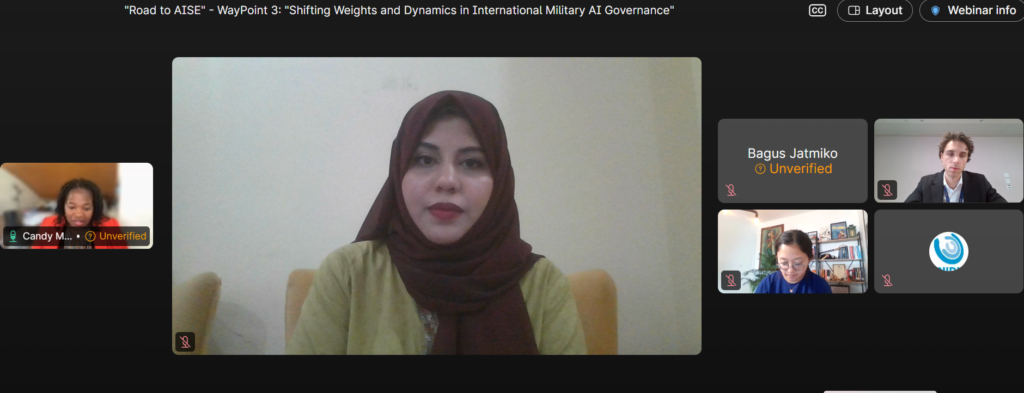
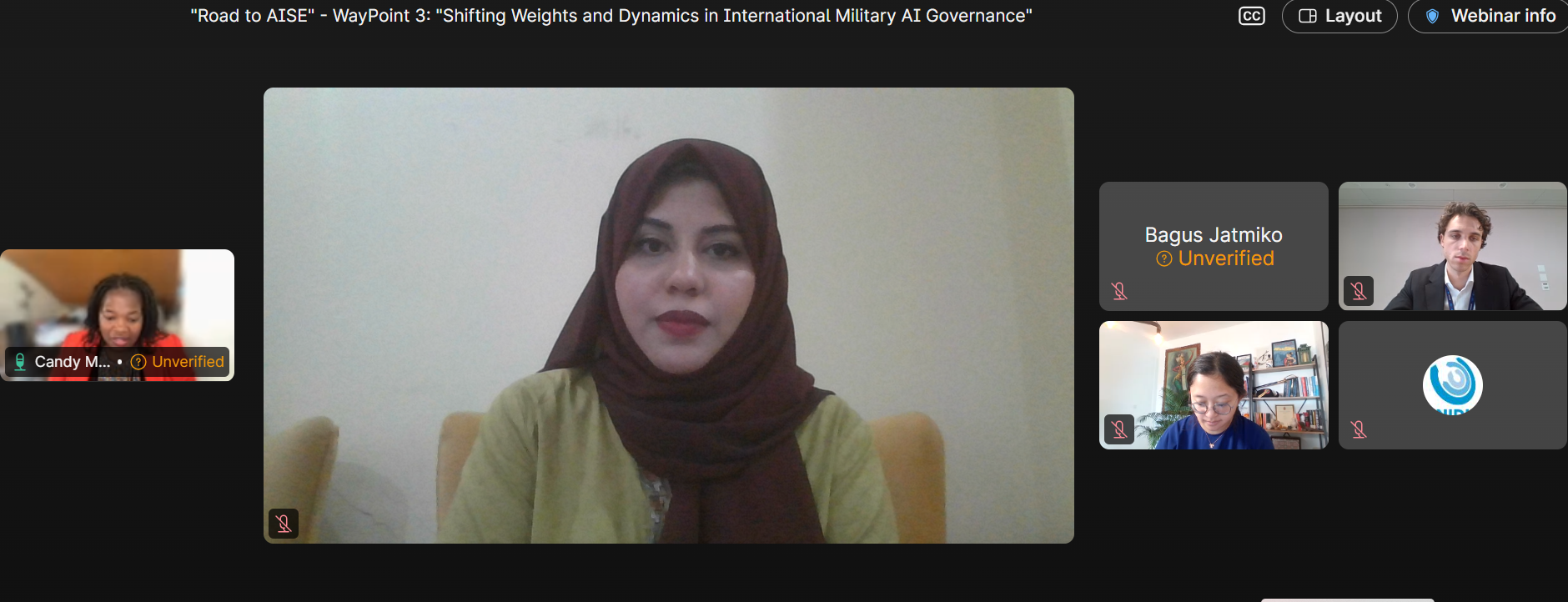
On 9th June 2026, the Network for Security, Strategy and Technology (NESST) participated in the United Nations Institute for Disarmament Research (UNIDIR) Road to AISE webinar series, contributing to a timely discussion on the evolving dynamics of international military AI governance.
The webinar, “Waypoint 3: Shifting Weights and Dynamics in International Military AI Governance,” brought together experts from different regions to examine how changing geopolitical realities, emerging technologies, and the growing role of small and middle powers are shaping global debates on artificial intelligence in the military domain.
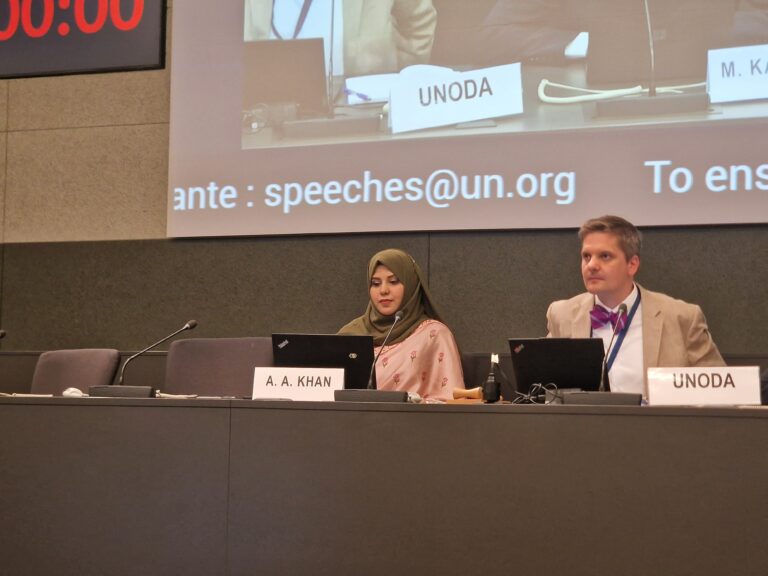
Representing NESST, Dr. Anum A. Khan delivered a presentation titled “Can Confidence-Building Measures (CBMs) Keep Pace with Military AI? Lessons from the India-Pakistan Nuclear Dyad.” The presentation explored how military AI is reshaping strategic stability, crisis management, and risk reduction in nuclearized environments, while drawing broader lessons for the international community.
A key theme of the intervention was that existing CBMs remain relevant but must evolve to address new sources of uncertainty created by AI-enabled military systems. The discussion highlighted how technologies such as real-time data fusion, predictive targeting, AI-enabled information operations, and cyber-AI interactions can compress decision-making timelines and increase the risks of misperception during crises.
Drawing on lessons from South Asia, Dr. Khan argued that the challenge of military AI is not simply technological but strategic. As she noted during the discussion:
“If nuclear deterrence was built around the fear of destruction, AI-era stability may increasingly depend upon managing the fear of misinterpretation.”
The presentation also examined how existing norms of restraint, including agreements relating to the non-attack of nuclear facilities, may face new pressures from the emerging AI-cyber nexus. It proposed the need for innovative approaches such as AI-assisted nuclear facility protection protocols, AI incident notification mechanisms, algorithmic pause principles, and new forms of confidence-building adapted to the realities of machine-speed decision-making.
The webinar further explored the increasingly important role of small and middle powers in shaping international military AI governance. Participants emphasized that future governance frameworks must be inclusive and reflect the experiences of regions that may experience the strategic consequences of military AI, even if they are not among the primary developers of these technologies.
The session featured distinguished contributions from:
- Dr. Bagus Jatmiko (Indonesian Navy) – Closing the dual gaps in military AI governance: Discourse and operationalization deficits for small and middle powers
- Dr. Anum A. Khan (NESST) – Can confidence-building measures keep pace with military AI? Lessons from the India-Pakistan nuclear dyad
- Candy Moyo (Department of International Relations and Cooperation, South Africa; Geneva Centre for Security Policy; University of Geneva) – Beyond consensus: Global South fragmentation and the limits of multilateral negotiation on lethal autonomous weapons systems
The discussion reinforced the importance of sustained international dialogue, inclusive governance processes, and innovative confidence-building measures to ensure that human judgment, strategic restraint, and responsible state behavior remain central in an increasingly AI-enabled security environment.