Dr. Anum A. Khan Participates in the International Webinar on EDTs, Perceptions, and Crisis Management in South Asia
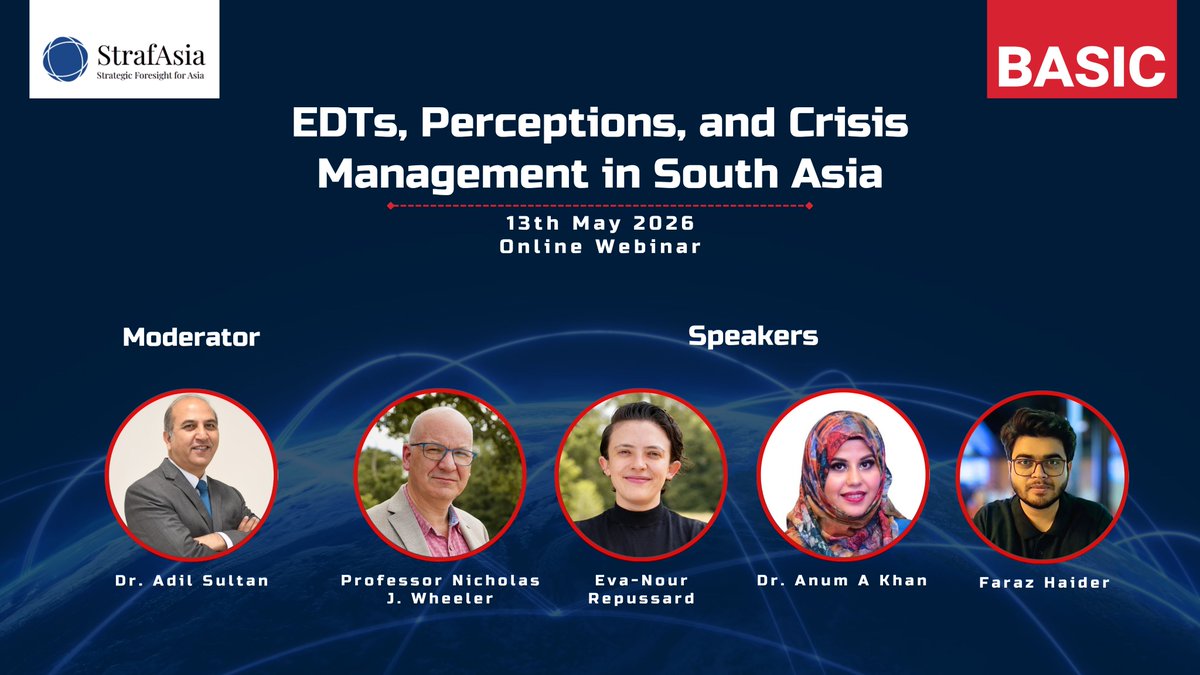
Dr. Anum A. Khan, participated as a speaker in the international webinar titled “EDTs, Perceptions, and Crisis Management in South Asia”, jointly organized by BASIC and StrafAsia Pakistan.
The webinar brought together leading scholars and practitioners working on strategic stability, crisis management, and emerging and disruptive technologies (EDTs) in South Asia. The discussion examined how AI, cyber capabilities, information warfare, autonomous systems, space technologies, and other evolving military innovations are reshaping deterrence dynamics between India and Pakistan.
Speakers Included:
- Professor Nicholas J. Wheeler
- Eva-Nour Repussard
- Dr. Anum A. Khan
- Faraz Haider
The session was moderated by Dr. Adil Sultan.
During the discussion, Dr. Anum A. Khan emphasized that the future risks in South Asia may no longer emerge solely from traditional military competition, but increasingly from “integrated technological ecosystems” involving AI-enabled ISR, cyber operations, digital misinformation, commercial satellite networks, autonomous systems, and algorithm-driven escalation pathways.
She highlighted that strategic stability debates in South Asia must move beyond conventional nuclear deterrence frameworks and account for:
- compressed decision-making timelines caused by AI-enabled warfare,
- the growing role of cognitive warfare and digital nationalism,
- risks posed by deepfakes and synthetic media during crises,
- and the increasing influence of non-state and private technological actors in future escalation scenarios.
Dr. Khan also noted that future crises may not unfold according to traditional escalation ladders, warning that “algorithmic speed could outpace political judgment,” thereby increasing the dangers of miscalculation and inadvertent escalation in the region.
The discussion further explored the need for:
- responsible AI governance in military domains,
- human control over critical strategic decision-making,
- new behavioral norms surrounding AI-enabled systems,
- and stronger Track 1.5 and Track 2 engagements focused specifically on EDT-related risks.